
Still in Tune
Finding rhythm in the things that don’t work anymore

Playing Through the Imperfect: The Keith Jarrett Lesson 🎶
I recently chatted with my old Penn concert production mate, Steve, who asked if I had heard the story of Keith Jarrett's Cologne (Köln) concert. I hadn’t, so he suggested I give it a listen, which I’m doing now as I write.
It’s a crazy story.
Jarrett was known for his improvised solo performances, in which he would walk on stage without a plan and create music in real time.
In January 1975, he shows up in Cologne for the show, and everything that could go wrong goes wrong.
He was exhausted, jet lagged, and dealing with intense back pain after a brutal drive through Europe. He arrived in Cologne, Germany, for a sold-out solo concert, expecting a pristine grand piano.
Instead, he found a wreck.
The piano was small, out of tune, and barely functional. The high notes were too thin, the bass lacked depth, and the pedals were broken. A disaster for any accomplished pianist—let alone one whose repertoire depended on the full range of the instrument.
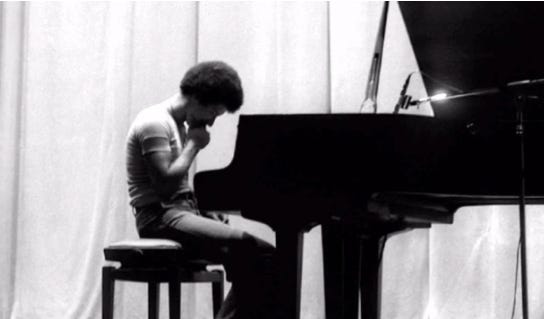
He told the organizers, “I can’t play this.”
They begged him to reconsider. And of course he did, or otherwise I’d have nothing to write.
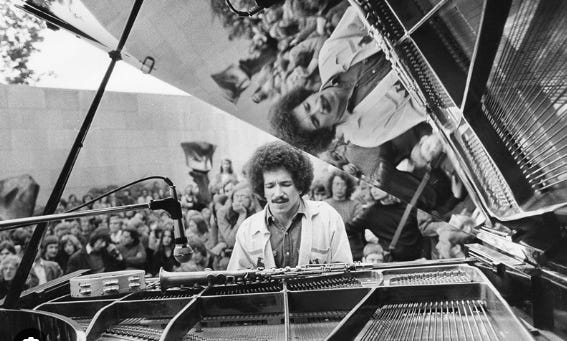
And that night, Keith Jarrett sat down at a piano he didn’t want to play—and created one of the great jazz recordings of all time.
If you haven’t listened to The Köln Concert, I recommend it. Once you know the backstory, it’s even more powerful.
The Art of Adapting
To compensate for the piano’s flaws, Jarrett did something remarkable: he completely adjusted his style to the piano’s limitations.
He had to avoid the upper and lower registers.
He leaned into the lower, resonant tones to compensate, building rhythmic patterns that felt almost hypnotic. He pounded out percussive beats to create depth where there was none.
In sum, he embraced the imperfection—and in doing so, created something new.
The audience sat mesmerized for over an hour.
The Köln Concert became the best-selling solo jazz album of all time. Not because everything went right, but because he played through what was wrong.
We All Get a Broken Piano Sometimes
Since Steve gave me the heads-up, I’ve thought a lot about this story. It has much to teach us about resilience, improvisation, and the beauty that can arise from limitation.
Because life rarely hands us a perfect instrument.
We all get a broken piano at some point. It can be a setback, a roadblock, a version of ourselves we didn’t want or see coming.
I’ve felt that.
I wasn’t just an athlete—I was movement. I ran, skied, biked. I traveled. My body was the instrument I knew inside and out.
And then, in an instant, it wasn’t.
I had to learn a new way to move. A new way to push forward.
Some days, I still hear the voice in my head saying, “I can’t play this. I can’t do this anymore”. I had one of those days this week.
But then there’s Keith Jarrett.
This story reminds me of something Leonard Cohen once wrote:
“There is a crack in everything. That’s how the light gets in.”
Play On
Maybe you’re dealing with your own broken piano.
Maybe something, or perhaps many things, you once did effortlessly now feel impossible.
Perhaps life has handed you an instrument that’s no longer in key.
But that doesn’t mean the music stops.
Play on.
Even if it’s different. Even if it’s harder. Even if you have to reinvent how you do it.
Some of the most meaningful performances happen when nothing goes as planned.
And sometimes, the beauty lives not despite the cracks, but because of them.
love your stuff ronnie...going thru a little bit of a trial in my old age as i write...always glad i ran into you at the Y....fish
Thank you! I always learn something from your essays, and this was one of the best.