
Docked

The New York Times ran a recent piece about friendship in adulthood.
The numbers weren’t particularly surprising. More Americans reported loneliness. Fewer close friends than a generation ago. The gradual disappearance of what sociologists call “third places” — the casual spaces where connection used to happen without much effort.
The advice wasn’t shocking, but it was still disheartening.
Don’t wait. Initiate.
Be consistent.
Fold friendship into ordinary routines.
Don’t expect it to sustain itself on nostalgia.
None of it felt groundbreaking.
Maybe it’s the cold, gray stretch of winter that has me thinking about mornings on the lake.
After my accident, many of those third places weren’t readily available to me. Homes I once moved through easily were no longer accessible. Golf. Wandering into a café. The kinds of casual, unplanned interactions I used to take for granted.
I had to seek connection more deliberately.
I wasn’t trying to build community.
I was trying to rebuild strength.
Reclaim a part of myself that felt lost.
Rowing became part of that.
Not because I was chasing a comeback story. I needed somewhere to go. Something structured. Something outdoors. A reason to get in the car and drive to the lake.
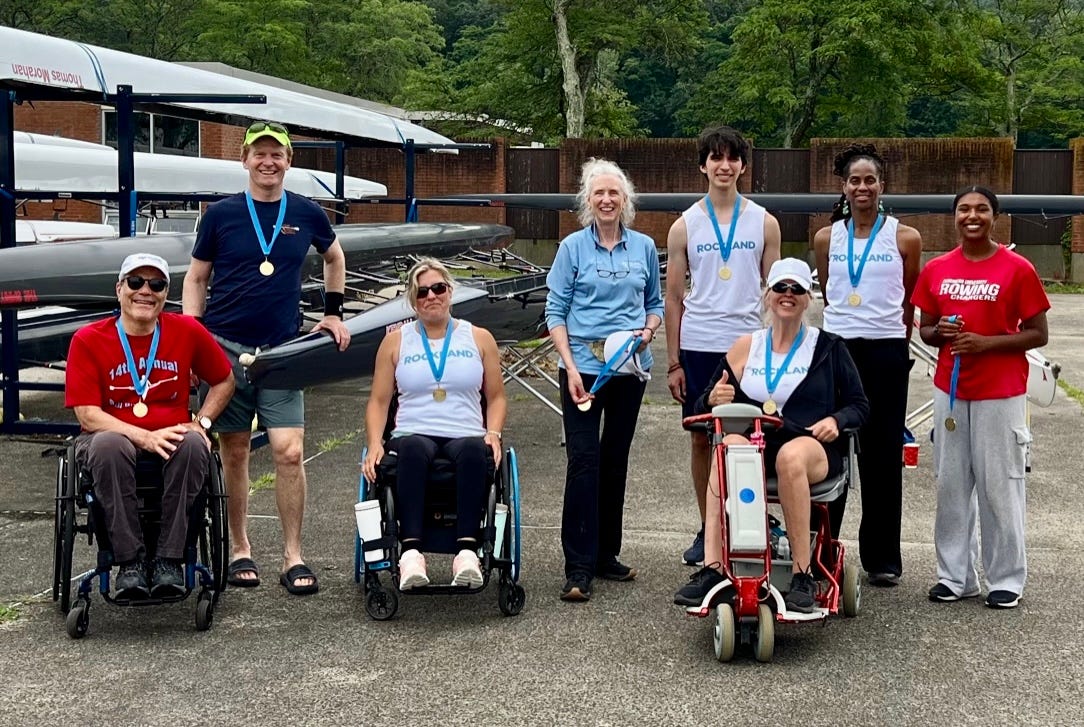
At Rockland Rowing, you can row a single or a double.
But either way, it’s never solitary.
There’s the choreography of getting boats down to the dock. The quiet rhythm of oars entering the water. Coach Greta’s voice drifting across the lake. Encouragement to push through the last 500 meters when your arms are burning and your mind is negotiating.
Sam is usually the first to arrive at the dock. She greets me with a smile. No fanfare. Just presence.
And always, the assumption is that you’ll be back next week.
You just show up.
The article discussed “shoulder-to-shoulder” friendship. The activity is the wrapper. The connection is the point.
That rang true.
We weren’t sitting in a circle, bitching about our challenges. We were working on timing, talking about wind and current, and noticing the light change across the water.
And in that repetition, we got used to each other.
Consistency over spectacle.
If one of us missed a few sessions, someone would reach out.
No pressure. No guilt. Just a simple check-in.
That carries weight. It assumes you belong. It assumes your absence is noticed.
Pararowing requires something else the article mentioned. Being a little bit needy.
I can’t carry my own shell.
I need help at the dock.
A hand into the boat.
There’s no hiding it.
It was uncomfortable at first. It still is. But it’s the price of getting into the game.
Connection isn’t dramatic.
Those voices on the dock are our “third places.”
Between land and water.
Where you accept a hand.
Where you offer one.
Where you’re expected back.
You don’t build community by talking about it.
You build it by showing up next week.
And the week after.
Thank you Ron!!! what a wonderful shout out for our program.